Wisdom Teeth Removal
Third molars, also known as wisdom teeth, is one of the most common conditions that is treated in the oral cavity. Most patients will have at least a few wisdom teeth that have erupted into the mouth or are still impacted inside the gum. Studies have shown that early consultations on mid-teenagers will have superior outcomes.
Some patients will be able to keep their wisdom teeth while others may have to remove them. Patients should be evaluated by the doctor and a discussion for each patient about the pros and cons for each individual case.
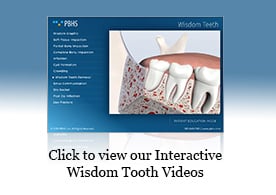
Wisdom Teeth Presentation
To provide you with a better understanding of
wisdom teeth, we have provided the
following multimedia presentation. Many
common questions pertaining to wisdom
teeth are discussed.
Why should I have my wisdom teeth removed?
Wisdom teeth should be removed before their root structure is fully developed. In some patients it is as early as 12 or 13, and in others it may not be until their early twenties. Wisdom tooth problems tend to occur with increasing frequency after the age of 25. Some of the possible problems related to not removing your wisdom teeth include:

Infection:
The most frequent clinical problem we see is pericoronitis (a localized gum infection). Without enough room for total eruption, the gum tissue around the wisdom tooth can become irritated and infected, resulting in recurrent pain, swelling, and problems with chewing and/or swallowing.

Cyst Formation:
Non-infectious diseases may also arise in association with an impacted wisdom tooth. Cysts are inside the jaw bone that develop as a result of impacted teeth and slowly expand, dissolving adjacent jaw bone and occasionally teeth.

Possible Crowding:
Impacted wisdom teeth may contribute to crowding of your teeth. There are a number of factors that cause teeth to crowd after braces or in early adulthood. More commonly is lack of retainer usage will cause crowding but wisdom teeth may be a contributing factor.

Damage to Adjacent Teeth:
If there is inadequate room to clean around the wisdom tooth the adjacent tooth can be adversely affected. This can result in gum disease, root resorption as shown, bone loss around the tooth, and decay.